

I've spent twenty years circling the same question from different angles. As a researcher, a teacher, a parent, a manager, a builder. Different contexts, different people, same observation: how we help people learn feels broken. Not the content. The experience. The way we expect people to go from "I heard about this" to "I can actually do this." That gap is where learning seems to die. And I've watched it happen from every seat in the room.
So I decided to stop watching and start building.
The Researcher
Twenty years ago, I was a PhD student in machine learning. Artificial intelligence, neural networks, evolutionary algorithms, stochastic optimization. Most of it was math or algorithms. But underneath the math, something fascinated me: the field was deeply biomimetic. We weren't inventing learning from scratch. We were borrowing from nature. Neurons, synapses, reinforcement signals, practical experimentation of learning, adaptation through feedback loops. We studied how living systems learn and turned those principles into repeatable processes.
At some point I started wondering about the reverse trip. If biological learning inspired machine learning, could machine learning teach us something about how humans can learn better? Not in a sci-fi way, in a practical way. What if the same principles that make an algorithm converge (exploration & exploitation, small steps, immediate feedback, spaced repetition, reward signals) could be applied to how we design learning experiences for people?
I didn't have the answer then. I filed the question away. But it never left.
The Teacher
I taught for five years in engineering schools at that time. Polytechnique, EFREI, Polytech Paris Sud. Standing in front of students, trying to make neural networks and robotics click. Some students got it instantly. Others struggled with the same concept for weeks. The difference wasn't intelligence. It was context: what they connected the material to, what interested them, when the lightbulb found its socket.
Then I stopped teaching. Moved into engineering, then management. Fifteen years passed.
Three years ago, I walked back into a classroom at EPITA. New generation, new tools, similar struggles. More content available than ever, and the same challenge to turn knowledge into skill when applying the concepts.
That's when the question came back with force.
The Parent
I have two kids. They couldn't be more different learners. Both are obviously smart (I'm a biased and proud parent). One absorbs information by reading, quietly, methodically. The other needs passion, understand, build something with their hands. Both are passionate about some domains, and push through on others where passion isn't the driver. Same household, same curriculum. Completely different paths to understanding.
Maybe the problem isn't the teaching. Maybe it's assuming one method fits everyone. Maybe it depends on interests, on the topic, on where you are in your own learning journey at that specific moment.
Most parents see this. Few have the tools to do anything about it.
The Manager
For the past eight years, I've led engineering teams. Smart, autonomous professionals who are perfectly capable of acquiring knowledge on their own. And that's exactly one of the problems I face.
Engineers learn what's in front of them. The current project, the current stack, the current fire to put out. They acquire skills reactively, in an operational way, shaped by whatever lands on their desk. In a fast-changing environment, this creates a dangerous pattern: people who are deeply competent in a narrow corridor and increasingly blind to everything outside it.
I've seen senior engineers who can architect a distributed system but can't explain their work to a stakeholder. Team leads who master Scrum ceremonies but have never thought about what makes a team actually healthy. Brilliant people with project-shaped skill sets in a world that rewards T-shaped ones.
The training solutions we throw at this don't always work. A short one-shot workshop doesn't build skills. A certification doesn't change behavior. An online course with a 12% completion rate doesn't do much of anything. Everyone seems to get it right: what works is sustained practice, small doses, immediate feedback, and a reason to keep going when it gets hard. The challenge is finding the strategic topics to focus on, the knowledge to acquire, the skills to build to make it useful... and when.
The Observer
There's a model I keep drawing on whiteboards. A circle with four stations.
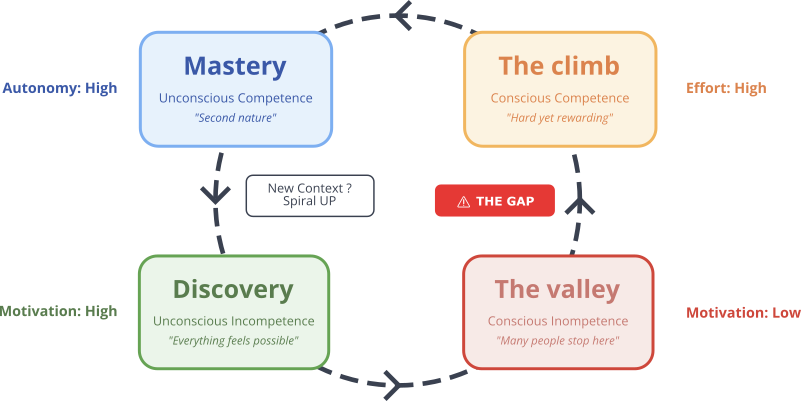
You start excited. You've discovered something new. Everything feels possible. You don't know what you don't know, and that ignorance feels like freedom.
Then the frustration hits. The tutorial worked, but your real problem looks nothing like the tutorial. You know enough now to see how far you are from competent. This is the valley. Most people stop here. They conclude the skill (methodology, technology, etc.) isn't for them, or was overhyped, or they don't have time.
If you push through, with effort, with practice, with someone showing you it's normal to struggle, you reach the third station. Conscious competence. You can do it, but it takes focus. Every step is deliberate. It's hard yet it's rewarding.
And eventually, if you keep going, the skill becomes part of you: second nature. You stop thinking about it and start doing it. Mastery.
But here's what makes it a spiral and not a circle: every time you change context, you re-enter the cycle. You master something in a sandbox, then face a production environment and you're back in the valley. You learn a framework with toy examples, then try to apply it to your messy real-world problem and the frustration returns. You're not starting from zero. The spiral goes up. But you do revisit each station, every time.
I've watched this same pattern play out with technologies. A new tool appears. Excitement. Promises. Then the harsh reality that there's far more work between the promise and the value delivered. Most organizations discard the technology right at the trough. The ones that push through do the disciplined, unglamorous work and eventually reach the plateau where it actually delivers.
People and technologies fail at the same point. Between the excitement and the effort. Between the promise and the practice.
Few disciplines build anything for that specific moment. One exception I can think of: software craftsmanship. We have dojos, katas, and deliberate practice formats that target the gap. Even then, we know the controlled setup of a kata is not the same as our actual work environment, with its constraints and messiness.
The Builder
I don't want to just build software or teams anymore. I've been building software for twenty years. What I want to build now is a system. A whole workflow that helps people cross that gap between "I discovered about this" and "I can actually do this."
That's Noosia. A gamified learning environment designed around the spiral. Micro-learnings that fit in five minutes. Quizzes or flashcards that give immediate feedback. Badges and rewards that keep motivation alive through the frustration zone. Learning paths that guide you from discovery to competence, not just through content, but through practice.
The gamification isn't decoration. It's structural. It's designed to do what a good teacher does: make the effort feel like progress, celebrate the small wins that keep you going when the valley feels deep, and show you that the spiral is going up even when it doesn't feel like it.
I'm building this in 1-hour evening sessions alongside a full-time job. One person, supported by AI agents (AI teams of agents actually) that handle content production, quality review, and operational workflows. It's modest, intentional, and built for quality over scale.
The Invitation
The MVP is nearly ready. Six features: quizzes, flashcards, badges, learning paths, a progress dashboard, and a gamification system designed to serve learning, not addiction.
Everything I've written about on this blog (craftsmanship, collaboration, learning cultures) led here. This is what happens when you try to build it yourself.
The beta is coming. If any of this resonates, follow along. I'll be sharing the journey, the mistakes, the lessons. Building in public, because that's how I think learning should work: out in the open, one step at a time.
The four-station model I describe draws on Noel Burch's Four Stages of Competence (1970s). The technology parallel references Gartner's Hype Cycle. The spiral dimension connects to Jerome Bruner's Spiral Curriculum (1960) and the Japanese concept of Shu Ha Ri. The synthesis is my own.
Produced with La Redaction: Margaux (🧭 Strategy), Lucien (✍️ Draft & Polish), Camille (🔍 Review), Farid (📢 LinkedIn), Solene (👑 Approval)
Status: BON A TIRER — approved for publication