Reading the Radar: How AI Became an Engineering Discipline in Twelve Months

Picture by Yifu Wu on unsplash
Every week, a new AI tool trends on social media. Every month, someone declares a paradigm shift. The noise is relentless, and if you're an engineering leader trying to make grounded technology decisions, it can feel like building on sand. New frameworks appear before you've finished evaluating the last one. Vibe coding dominates the conversation, carrying the torch of the low-code/no-code movement for a new audience of non-engineers building apps. Meanwhile, professional engineering teams are solving fundamentally different problems.
But underneath the buzz, something quieter is happening. Something more durable.
Twice a year, thousands of technologists across the globe compile what they actually see in the field. Not what vendors promise. Not what conferences hype. What practitioners observe on real projects, with real constraints, for real clients. The ThoughtWorks Technology Radar has been doing this for fifteen years and thirty-three editions. Most engineering leaders skim it in ten minutes. They're missing the point.
The Radar is not a trend report. It's an observatory. And if you read the last three volumes back to back, a pattern emerges that no single edition reveals on its own: while the surface churns with hype and hot takes, AI is quietly structuring itself into an engineering discipline. The foundations are forming. The vocabulary is stabilizing. The practices are maturing. And this structure persists, regardless of which tool is trending this week.
Good news. You can keep your head cool and focus on what matters: making it happen.
The Radar as Observatory
The Technology Radar was born in 2010 when ThoughtWorks' Technology Advisory Board decided to formalize something they'd been doing informally: tracking what their consultants were actually using, adopting, and abandoning across hundreds of client engagements worldwide. Darren Smith came up with the radar metaphor. Flatten every technology onto a circle, position it by maturity, and you get a visual map of the industry's real state.
The format is deceptively simple. Four quadrants (Techniques, Platforms, Tools, Languages & Frameworks) crossed with four concentric rings: Adopt, Trial, Assess, Hold. Each technology is a "blip" placed on the radar based on collective field experience. You can explore the interactive Radar yourself. Thirty-three editions later, the methodology hasn't changed much, but the credibility has compounded. There's one rule that makes it work: ThoughtWorks doesn't talk to vendors. The only way onto the Radar is if a technology is used on a real project and a practitioner proposes it.
That constraint is what makes the Radar rare. In an industry flooded with sponsored reports and analyst quadrants, this is field data from people who ship software for a living. It's also why companies like Zalando, Spotify, Porsche, and the CNCF have adopted the format to build their own internal radars. The model works because it forces a simple, honest question: are we actually using this, and how is it going?
What the Last Three Volumes Reveal
Read Volume 31 (October 2024), Volume 32 (April 2025), and Volume 33 (November 2025) in sequence, and you're watching a technology domain mature in real time.
October 2024 (Vol. 31): The Explosion
The Radar called it a "Cambrian explosion of the AI-adjacent ecosystem." Fair description. Coding assistants were multiplying. New GenAI frameworks appeared every week. But the most telling signal wasn't what was new. It was the first theme: "Coding assistance antipatterns." Barely a year into mainstream AI coding tools, the industry was already generating enough bad patterns to warrant a warning. Overreliance on generated code, codebase bloat, erosion of developer understanding. The Radar was saying: slow down, the tools are powerful, but the practices aren't mature yet.
April 2025 (Vol. 32): The Structuring
Six months later, the tone shifted. The explosion phase was over. The four themes told the story: supervised agents in coding assistants, the "R" in RAG getting serious engineering attention, observability evolving to handle LLMs, and data product thinking gaining traction. Each theme pointed to the same thing: the industry was moving from "try everything" to "engineer it properly."
AI coding assistants were no longer autonomous experiments. They were supervised workflows. RAG wasn't a buzzword anymore. Teams were building corrective RAG, fusion RAG, self-RAG, and comparing retrieval strategies with engineering rigor. LLM observability was becoming a real discipline, not an afterthought.
November 2025 (Vol. 33): The Consolidation
Volume 33 confirmed the trajectory. While vibe coding continued to thrive as an accessible entry point for non-engineers, the Radar told a different story for professional engineering teams. Rachel Laycock, ThoughtWorks' CTO, described "a concerted and serious effort to think through problems of context, infrastructure and security." The four themes this time were all AI, and all about engineering maturity: infrastructure automation for AI workloads, the rise of agents via MCP (Model Context Protocol), the evolution of AI coding workflows, and emerging AI antipatterns.
Two signals stood out. First, context engineering emerged as a unifying concept. Not just prompt engineering, not just RAG, but the deliberate engineering of how AI systems receive, manage, and use context. The field is developing its own vocabulary, its own abstractions. This is what disciplines do. Second, Anthropic's MCP protocol went from open-source release to thousands of server implementations in under a year. Every major platform is integrating it. Not hype adoption. Infrastructure formation.
The Arc: From Chaos to Discipline
To make this trajectory visible, I curated the AI-related blips from the last three volumes into a custom Technology Radar you can explore interactively. The pattern is striking: techniques that were in Assess during the explosion moved to Trial during structuring, while the first Hold blips (antipatterns) appeared almost immediately and persisted across all three volumes.
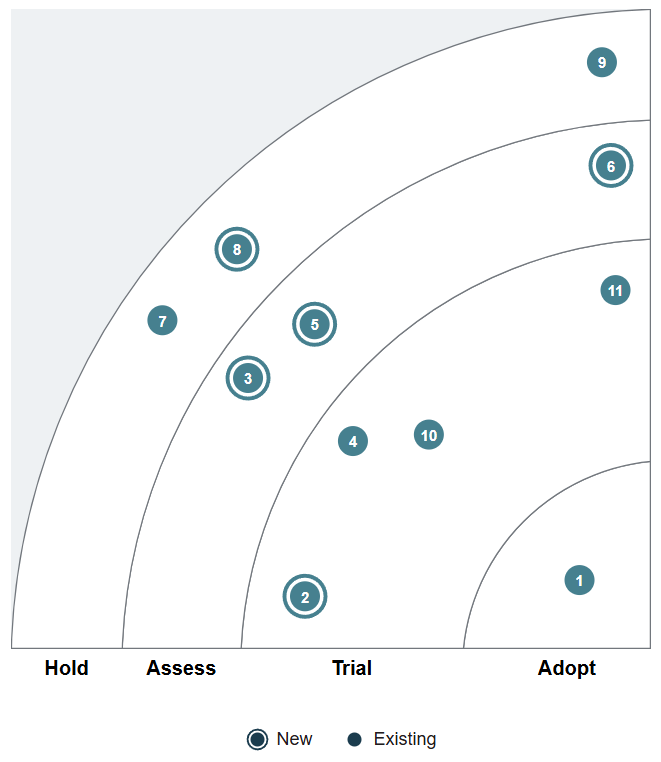
Figure 1: Example quadrant for the example custom tech radar
Step back from the individual blips, and the 12-month arc across these three volumes tells a story that anyone who's been in tech long enough will recognize.
Explosion. Structuring. Consolidation.
Cloud computing followed this exact pattern. So did DevOps. So did microservices. First, a burst of tools and experiments. Then, hard lessons and emerging practices. Then, consolidation around protocols, infrastructure, and shared vocabulary. The speed is different (AI is compressing this cycle into months, not years), but the shape is the same. A technology wave becomes an engineering discipline when it develops its own antipatterns, its own observability, its own infrastructure layer, and its own vocabulary. AI crossed that threshold in 2025.
No single conference talk or vendor report captures this: the progression. One volume shows you blips. Three volumes show you a trajectory.
Why This Matters Now
For engineering leaders, the structuring phase is where decisions carry the most weight. During the explosion, everything is experimental and low-stakes. After commoditization, the choices are made for you. But right now, in the structuring phase, you're choosing which practices to adopt, which protocols to invest in, which antipatterns to avoid. These choices compound.
The Radar won't make those decisions for you. But it will show you what thousands of practitioners are converging on, and what they're backing away from. That's a better signal than most strategy decks. And it's a reminder that you don't need to chase every new release to stay relevant. The structure is forming. You can lean on it.
Start Here
The Technology Radar is free, published twice a year, and takes about an hour to read properly (not ten minutes). Read it with your tech leads. Discuss which blips matter for your context. Better yet: build your own company radar. Zalando, Spotify, and dozens of others have done it. The format scales, and the exercise of placing technologies on rings forces the kind of honest, collective conversation that most organizations avoid.
The next volume will land in spring 2026. Between now and then, a new wave of tools will trend, a new buzzword will dominate LinkedIn for a week, and someone will declare that everything has changed again. Some of it will matter. Most of it won't. The Radar will help you tell the difference.
Keep your head cool. Focus on the structure, not the noise. And make it happen.
Produced by La Redaction: Margaux (🧭 Strategy), Lucien (✍️ Draft), Camille (🔍 Fact-check & Review), Farid (📢 Platform & Visuals), Solene (👑 Final Approval) Status: BON A TIRER — approved for publication