Knowledge Silos as Organizational Debt: Why Collaboration is Risk Management


As an engineering leader, you face constant pressure: deliver features at pace while maintaining code quality, system stability, and team wellbeing. In this pursuit of efficiency, the "solo developer" model is seductive—the ultra-productive expert, headphones on, solving problems in isolation. But this model, appealing as it seems, creates hidden risk that can create significant organizational fragility.
This post argues a counter-intuitive principle: collaborative development practices like pair programming and systematic code review aren't operational overhead. They're strategic investments that strengthen team resilience, improve software quality, and ultimately reduce long-term costs by preventing systemic failures.
We'll start by identifying the hidden cost of knowledge silos and quantifying their impact. Then we'll examine the business case for shifting from individual output to collective capability. We'll explore the fundamental practices that make collaboration tangible and effective, before concluding with an action plan for building a sustainable collaborative culture.
The Hidden Debt: Identifying and Quantifying Knowledge Silos
A knowledge silo forms when critical system information is held by a single person or very small group. Far from being a mere organizational inconvenience, silos represent a direct strategic threat to your engineering team's velocity, stability, and sustainability. They're a form of technical and human debt that accumulates silently until crisis reveals it brutally.
Consider the "bus factor": how many team members would need to be hit by a bus before a critical system becomes unmaintainable? Take Sarah, the only developer who understands your payment system. When a bug appears, only Sarah can fix it. When a new feature is needed, only Sarah can implement it. If Sarah takes vacation, all payment-related work stops. If Sarah leaves the company, you face a major crisis—costly work stoppage and tangible business risk.
Knowledge silos aren't always this obvious. They manifest through recurring patterns that progressively degrade team performance.
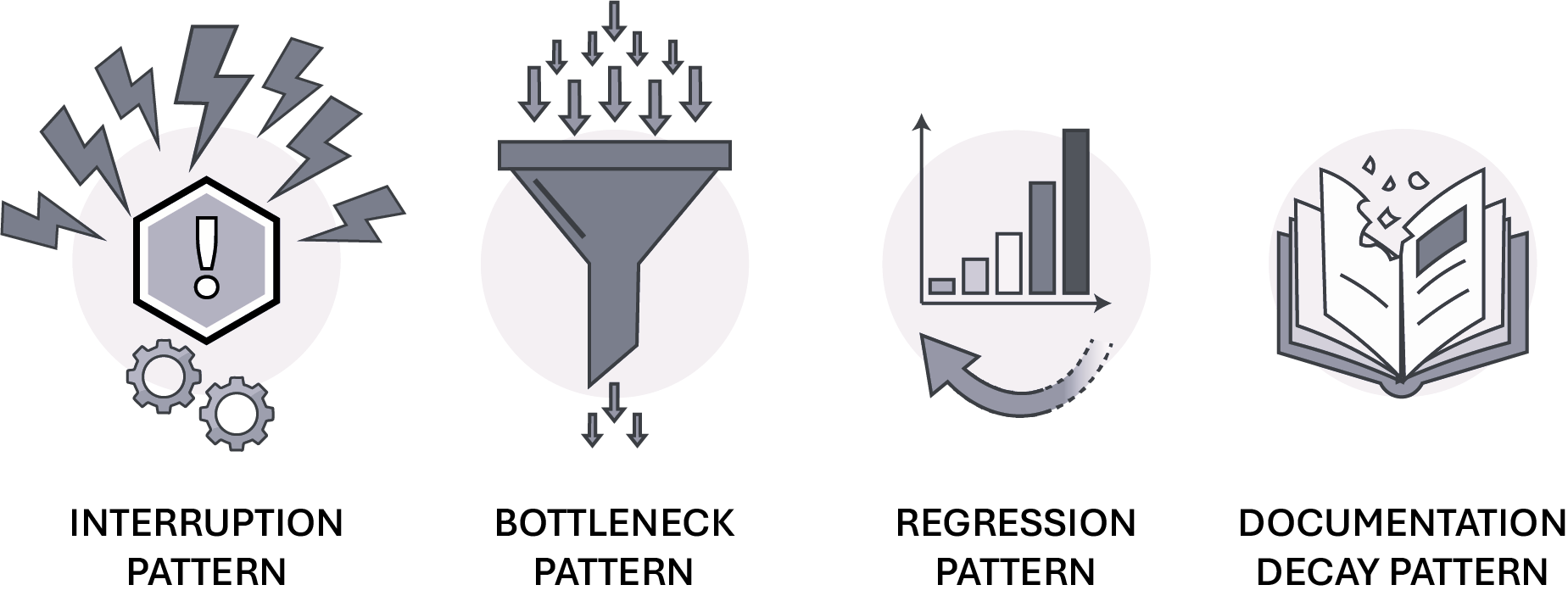
The Interruption Pattern
Constant questions like "Can you explain how this service works?" fragment your experienced developers' days. Each interruption breaks their concentration, while the junior developer asking the question remains blocked awaiting a response. These micro-disruptions, accumulated, represent significant productivity loss for the entire team.
Pair programming transforms the question "Can you explain?" into a working session "Let's build this together," eliminating the interruption at its source.
The Bottleneck Pattern
When a single expert owns a domain, critical features accumulate in their queue. This person becomes overloaded, stressed, and unable to take perspective or time off. Team velocity doesn't suffer from lack of overall capacity, but from poor skill distribution.
Code review and pair programming distribute skills, transforming the single point of failure into collective capability.
The Regression Pattern
A developer modifying unfamiliar code risks introducing bugs inadvertently. They don't grasp the implicit assumptions, edge cases, or system integration points. These regressions propagate to production, eroding user confidence and requiring costly emergency fixes.
Continuous review—whether paired or asynchronous—ensures a familiar eye validates each change, catching potential regressions early when fixes are still trivial.
The Documentation Decay Pattern
The most common solution to silos is written documentation. Unfortunately, it becomes quickly outdated as code evolves. Developers stop trusting and consulting it, worsening the original problem rather than solving it.
Collaborative practices create living documentation, embodied by the team's shared knowledge, that stays synchronized with the code.
These patterns aren't inevitable. They're symptoms of insufficient active knowledge sharing. Collaborative practices, by integrating this sharing into the development process itself, attack these problems at the root.
The Strategic Shift: From Individual Output to Collective Capability
The most common objection to collaborative practices is economic: "Why pay two developers to do one person's job?" This question, while legitimate, rests on a limited view of productivity. It ignores the massive indirect costs generated by silos and the exponential gains of a team with shared skills. Collaboration isn't an expense—it's a risk management strategy and long-term value optimization.
Research like the Accelerate State of DevOps reports suggests that high-performing teams tend to integrate robust collaborative practices. They observe measurable, significant advantages:
- Lower defect rates, as fewer production incidents require widespread emergency intervention
- Faster new member integration, becoming productive in weeks rather than months
- Better work-life balance, as the absence of unique heroes avoids burnout and constant on-call situations
- Higher personnel retention, as developers thrive in environments where they learn and feel supported
The economic argument becomes clear when comparing two teams. A team of five specialists working in silos is fragile—one person's departure or absence can paralyze a project. Conversely, a team of five developers with shared knowledge is resilient. It has no single points of failure, code reviews are faster because multiple people can contribute, and output quality is inherently superior through continuous perspective confrontation.
The real strategic lever: for many teams, investment in collaboration during development costs far less than paying for production incidents, missed deadlines, emergency hiring, and personnel attrition.
But there are constraints. Not every team can afford the upfront cost of pairing, even if the ROI is positive. Small startups burning cash may need to optimize for short-term feature velocity. Remote teams across timezones face coordination challenges that make real-time pairing difficult. Teams larger than 15-20 people need different collaboration structures than tight-knit squads.
The question isn't "should we collaborate or not?" It's "given our constraints, what collaborative practices give us the best resilience-to-cost ratio?"
For that investment to bear fruit, understanding the concrete mechanisms that enable it is crucial. That's where the fundamental practices of pair programming and code review come in.
Fundamental Practices for Team Resilience
Pair programming and code review constitute the two technical pillars supporting an effective collaborative culture. They're not rigid dogmas to apply blindly, but flexible disciplines with specific techniques that can and should be adapted to your team's context, task complexity, and members' experience.
Pair Programming: Structured Real-Time Collaboration
Pair programming is a practice where two developers work together at the same workstation to solve the same problem. Far from simple observation, it's simplest format relies on a clear structure: the Driver-Navigator model.
- The Driver controls the keyboard. Their role is tactical: write code, run tests, focus on implementation details of the current task.
- The Navigator observes, analyzes, and guides. Their role is strategic: review each line of code as it's created, anticipate next steps, think about overall architecture, and identify potential problems or edge cases.
This division of labor creates a powerful dynamic where the driver's tactical focus is complemented by the navigator's strategic vision. The benefits of this synergy extend far beyond simple bug detection:
- Continuous Code Review: Each line of code is validated by a second person at the moment of creation, when context is fresh and corrections trivial.
- Accelerated Knowledge Transfer: Learning happens through osmosis and action. Junior developers learn team standards; seniors discover new perspectives.
- Reduced Context Switching: Both developers stay deeply focused on a single task, avoiding interruptions and cognitive load from multitasking.
- Integration Accelerator: A new team member can become productive in weeks by pairing with experienced colleagues, instead of the months solo ramp-up would take.
This practice, however, isn't a universal solution. It's essential to know when to use it to maximize value.
When to Pair:
- Complex features requiring design decisions
- Knowledge transfer (onboarding, expertise sharing)
- Debugging difficult problems in unfamiliar code
- Critical code where errors are costly (payments, security)
- Reducing future interruptions on complex work
When to Work Solo:
- Routine, well-understood tasks (typo fixes, simple CSS)
- Exploratory research or individual prototyping
- Personal learning objectives (reading docs, training)
- Fatigue periods where intense communication would be counterproductive
Adapting the Practice: Pair Programming Styles
Pair programming isn't monolithic. It's a flexible toolkit. Mastering different styles lets your team adapt to the task at hand.
-
Driver-Navigator: The default pairing model. One person (driver) controls the keyboard and focuses on tactical implementation—writing code, running tests, handling details. The other (navigator) reviews each line as it's created, thinks strategically about architecture, anticipates next steps, and identifies potential problems or edge cases. This division of labor creates a powerful dynamic where tactical focus is complemented by strategic vision.
-
Strong-Style Pairing: Ideal for teaching and knowledge transfer. The rule is simple: "For an idea to go from your head to the computer, it must pass through someone else's hands." The navigator, who has the knowledge, dictates all actions to the driver, who focuses on input. This forces the expert to verbalize their knowledge and allows the novice to absorb it through action.
-
Ping-Pong Pairing: Perfect for Test-Driven Development (TDD). The rhythm is simple: Developer A writes a failing test. Developer B writes code to pass the test, refactors, then writes the next failing test. The keyboard passes to Developer A, and the cycle repeats. This style guarantees balanced participation and reinforces TDD discipline.
-
Evil Twin (Devil's Advocate) Pairing: Useful for strengthening test coverage and code robustness. One developer writes tests, the other intentionally tries to write code that passes those tests while introducing subtle edge cases or potential bugs. The first developer then strengthens the tests to catch these issues. This adversarial-but-collaborative dynamic surfaces gaps in test coverage and edge cases that might otherwise be missed. Works well when both developers have similar experience levels.
-
Silent Pairing: Pairs work together with minimal verbal communication, relying primarily on code, tests, and occasional written notes or gestures. Useful when you need deep focus on complex logic, when working across language barriers, or when one person is still learning and benefits more from observation than explanation. Some developers find this less draining than constant discussion, though it requires strong code readability and clear test names to communicate intent.
Quick Reference:
| Style | When to Use |
|---|---|
| Driver-Navigator | General purpose pairing; default for most collaborative sessions |
| Strong-Style | Teaching and knowledge transfer; onboarding; sharing expertise |
| Ping-Pong | Test-Driven Development; ensuring balanced participation |
| Evil Twin | Strengthening test coverage; finding gaps in test suites |
| Silent | Deep focus work; language barriers; reducing communication fatigue |
Pairing has real costs though. It's mentally intense—you probably can't sustain 8-hour pairing sessions without burning out your team. Remote pairing via screen-sharing tools adds Zoom fatigue. Some developers (particularly those who are neurodiverse or introverted) may find constant real-time collaboration draining.
The solution isn't to abandon pairing. It's to use it strategically where the knowledge-sharing value exceeds the coordination cost, and complement it with asynchronous collaboration.
Code Review: Asynchronous Collaboration Focused on Sharing
If pair programming is synchronous, code review is its asynchronous counterpart. Its primary objective shouldn't be gatekeeping, but knowledge sharing. A code review designed as a barrier creates a confrontational climate. A code review designed as dialogue fosters collective learning.
Compare these two approaches:
- Gatekeeping comment: "This is wrong. Use our AuthHelper service."
- Constructive comment: "Nice approach! I wonder if we could simplify the logic by using our AuthHelper here. It already handles token refresh cases, which would save us rewriting this part. What do you think?"
The second comment is educational, respectful, and opens discussion. To guarantee this quality of exchange, human reviews must focus on what automated tools can't see:
- Design and Architecture: Does the change integrate well with existing architecture? Is there a simpler or more maintainable approach?
- Business Logic and Correctness: Does the code correctly solve the stated business problem? Are edge cases handled?
- Tests and Coverage: Are tests readable? Do they cover both nominal scenarios and relevant error cases?
- Security and Reliability: Are user inputs validated? Are sensitive data handled securely?
- Readability and Clarity: Could a new team member understand this code? Are variable and function names explicit?
To eliminate ambiguity in comments, a practical solution is adopting Conventional Comments. This simple format uses labels to clarify the reviewer's intent:
- PRAISE: Highlight a particularly well-designed solution
- SUGGESTION: Propose a non-blocking improvement
- ISSUE: Signal a blocking problem that must be resolved before merging
- QUESTION: Ask for clarification
- NITPICK: Minor stylistic remark, non-blocking
- TEACHING: Share knowledge without requiring modification
Example structured review:
PRAISE: Excellent use of the Strategy pattern here, very clean!

SUGGESTION (non-blocking): Could we extract this logic into a private method
to improve readability?

ISSUE (blocking): Warning, this query isn't protected against SQL injection.
It must be fixed before merging.
But code review has failure modes too. Reviews that sit for days waiting for approval become bottlenecks. Pull requests with 1000+ lines of changes are impossible to review meaningfully. Teams without clear review SLAs see PRs languish, killing momentum.
The solution: team agreements on PR size limits (400 lines max), review SLAs (first review within 4 working hours), and who can approve what (domain experts vs. anyone on team).
These technical practices, powerful as they are, can only thrive in a cultural environment that actively supports them.
Building a Sustainable Collaborative Culture
Adopting collaborative tools and practices is doomed to fail without a solid cultural foundation. Your role as a leader isn't to impose a methodology, but to build the cultural ecosystem where high collaborative performance becomes inevitable.
The foundation of this environment is psychological safety. Developers must feel safe asking questions they consider "stupid," admitting mistakes without fear of reprisal, and proposing alternative ideas without fear of ridicule. As a leader, you can build this safety by celebrating learning moments, modeling vulnerability ("I don't know the answer, let's search together"), and treating incidents as system failures, not individual faults.
On this foundation, creating team agreements is essential. Rather than imposing practices top-down, facilitate a discussion for the team to define its own rules of engagement.
Example pairing agreement: "We pair on complex features or when onboarding a new member. Any member can request a session anytime. We take a 5-minute break every hour and ensure we change pairs at least once per week to spread knowledge."
Example code review agreement: "Each pull request must be under 400 lines of change. It receives initial review within 4 working hours. We use Conventional Comments. The author can merge after one approval, unless a blocking ISSUE is raised."
These agreements work because they're explicit, negotiated by the team (not imposed), and include specific guardrails that prevent collaboration from becoming exhausting. The key insight: collaboration isn't an accident—it's a discipline that requires intentional structure adapted to your context.
Your structure will differ based on your constraints. A product company with 5-year average tenure has different knowledge-sharing needs than a consultancy where developers rotate every 6 months. A 50-person engineering org needs different structures than an 8-person team. Remote-first teams need different coordination mechanisms than co-located squads.
The common thread across successful collaborative teams isn't the specific practices they use, but that they make collaboration explicit, measurable, and sustainable rather than leaving it to chance.
Measuring Collaborative Health
To drive this transformation, you need to measure collaboration quality. Rather than tracking individual productivity metrics (like lines of code written) that create perverse incentives, focus on collective health indicators:
- Bus factor of critical systems — How many developers understand each critical system well enough to maintain it?
- Review cycle time — How quickly do PRs move through review? Long cycle times indicate bottlenecks or insufficient reviewer capacity.
- Pairing frequency on complex tasks — What percentage of high-complexity work involves pairing? Low percentages suggest silos are forming.
- Knowledge distribution across domains — Track which developers have committed to which systems over the past quarter. Highly concentrated commit patterns indicate silos.
These metrics aren't goals in themselves. They're early warning signals that help you spot silos before they become crises.
Your Next Steps
Knowledge silos aren't inevitable—they're a form of costly technical and organizational debt. Collaboration isn't a luxury—it's a profitable investment that improves resilience, quality, velocity, and retention. Its implementation isn't a brutal revolution, but a progressive process that starts with concrete steps, supported by a culture of trust and psychological safety.
To begin this transformation, here's a simple action plan you can start today:
- This Week: Propose to your team to schedule a one-hour pair programming session on a complex problem or tricky bug. Observe the dynamics and discuss at your next team meeting.
- This Month: Suggest experimental adoption of Conventional Comments in code reviews. Ask the team if it improves clarity and tone of exchanges.
- This Quarter: Launch an initiative to map the "bus factor" of your most critical systems. Identify domains where knowledge is most concentrated and plan sharing sessions (like targeted pairing) to address it.
Adopting these practices isn't just improving a process. It's transforming how your team designs, builds, and maintains software—making it more sustainable, more human, and ultimately more performant.
Further Reading
- Accelerate: The Science of Lean Software and DevOps by Nicole Forsgren, Jez Humble, and Gene Kim
- Extreme Programming Explained by Kent Beck (on pair programming origins and philosophy)
- Conventional Comments specification: conventionalcomments.org